Monday, 8 August 2016

MAKING A CASE FOR POOR READING CULTURE IN NIGERIA

 By: Olawale Oluwadahunsi on: July 16, 2014
In THE NATIONAL MIRROR Arts, Arts and Lifestyle, Culture >http://nationalmirroronline.net/new/making-a-case-for-poor-reading-culture-in-nigeria/

Reading culture in Nigeria is at its lowest ebb, and experts are worried that this portends a dangerous omen for the countrie’s future. Read how the tidal wave could be fought to a standstill in this piece.


If the future of Nigeria will be anything close to projections in terms of education, reading is one formidable tool that the country cannot do without.

Reading books is like a journey because it takes one beyond time and space. Reading challenges and agitates one’s mind. It shifts one’s paradigm and places before one a possible and preferable future and re-orients people’s mentality.

Recent interviews with celebrities like Taiwo Ajai-Lycett, and Yemi Blaq give a clear picture of what the culture of reading they imbibed from their childhood has done to them.

Mrs Taiwo Ajai-Lycett explains that “Books were in high regard just like films such that we look forward to read new books every week”, and in consonance, Yemi Blaq says “I love to read a lot; reading was fun to me. As a result of that, I have a lot of materials to read at home. Today, much reading has made it easy for me to communicate with a lot of people around the world, especially on different subjects. It always amazes people how I am at home with different subjects. I usually tell them that I learnt it when I was growing up”

If reading is such a wonderful experience armed with adventurous and scintillating benefits, then why is Nigeria not imbibing the culture?

In Nigeria, a study carried out 2004, reveals that 40 percent of adult Nigerians never read a non-fiction book from cover to cover after they finish school. The average Nigerian reads less than one book per year, and only one percent of successful men and women in Nigeria read one non-fiction book per month. The same study showed that 30 million Nigerians have graduated from high school with poor reading skills.

A writer, Matthew Ujah-Peter, with The Reading Culture book Club reiterates the decadence of reading in Nigeria.

“When a book expo or book fair is organised by some institutions and organisations in the country, amazement and disappointments are at its peak as there is low turnout of people in such events.

Every year the Lagos Television (LTV), the Nigerian Television Authority (NTA), the Christian Bookseller Association ( CBAN), Committee for Relevant Art (CORA), The Nigerian Book Fair Trust (NIBFT), FARAFINA and recently, the Rainbow Book Club, Port Harcourt, organise book cantred events like book fairs, art and book festivals, book expo. But how many Nigerians make out time out of their ‘’busy schedule’’ to attend these and savor the arrays of books on display?

The lack of interest and apathy shown towards such events here in Nigeria is a clear testimony to the fact that most Nigerians do not place much value on books and reading. There has always been low turnout in most of these events compared to such events in other climes”.

“In Nigeria, public awareness is still very low and attendance is also painfully low as most of these events are attended only by a few. Book shops are rarely patronised by most Nigerians and libraries are seen as a place for those studying for examinations and researchers. Indeed the level of interest shown by the average Nigerian towards books and reading still leaves much to be desired”.

Another possible reason is because most Nigerians see book reading as cumbersome and prefer to be entertained with beauty pageants, films, and the use of ICT devices.

President Goodluck Jonathan lamented the negative impact of internet and the social media on the reading and writing culture in Nigeria, saying that Federal Government which has been doing everything to reverse the dwindling culture, may be compelled to re-launch “Bring Back the Book” programme.

According to the President, “It often worries me in terms of how to increase our writing culture in our country these days of internet and text messages that people don’t like to write long sentences again. I know people like these are used to reading very short things; they didn’t have the interest to read the novel that we used to read in our days. I don’t know what the association has been doing”

Executive Director, Institute of Media and Society, Mr. Akin Akingbulu said another factor that contributes to poor reading culture is the prices of books which are on the high side.


“In our days, you could pick a Chinua Achebe’s or Wole Soyinka’s book for just N150 if you wanted a novel to read. But now the prices have gone up. You get to a book store and you are asked to pay N700 or N800 for a book. So the affordability becomes an issue to many children who would have wanted to read,” he said.

He added that the Nigerian environment has also contributed to the reduction in reading culture among youths. He noted that the young generation sees the leaders pocketing so much money and breeds the feeling that there is always a short cut to making money.

Bad as the situation may seem, there is a way out. Mr Nkannebe Raymond, an educational observer says all the there must be a synergy among the family, the government and organized private sector as they have a great role to play in bringing back the book on people’s mind, in the development of young writers who are mostly avid readers in order to engender the performance of men and women who believe in the paradox that the pen is mightier than the sword.

Viewers can only end up practicing and advancing the kind of life style that greet them every now and again as they switch their T.V sets or tune in to various radio stations and who are these viewers? The notion that whether one reads or not cannot change the situation of things has been crested in the gullible minds of all and particular mention must be made of the youth population who we are told are the leaders of tomorrow.

TV and radio programmes every now and again, bother us with content that bother on the promotion of other skills with the influential private sector coming in to sponsor and advertise its products and in the process, make stars and celebrities of the participants at the end of the day thereby, leading the gullible minds of the youth into believing that its greener on the other side.

Parents should guide their wards into reading anything that comes their way irrespective of subject and give out prizes where tenable at the family level in order to encourage and serve as incentive to others. The school system cannot be left out in this. They should make reading and short story writing a part of their syllabus in order to propagate the trend and help in catching them young.

The government at all levels should sponsor literary works of young writers and consider aspiring writers for publication as the dream of every young writer is to ne published. Literary clubs and publishing houses like Farafina Books and a host of others should be partnered with in helping to harness the literary deposits untapped in our population and excellence awarded where it is attained. Literary/writing workshops/book reading seminars should form the agenda of the education ministries and adequate funds released to ensure its actualisation while keeping corruption at its lowest ebb.

The organised private sector must be encouraged to extend their charity and supposedly reward excellence in the areas of reading and writing as it forms part of their corporate social responsibility.

Exterior of the National Library of Nigeria, Yaba, Lagos

Thursday, 4 August 2016

SEFI ATTA


Born in Lagos, Nigeria, in 1964  to a family of five children, Sefi Atta attended  Queen's College, Lagos, Millfield School, England and graduated from Birmingham University in 1985. She also trained as a chartered accountant.  Her father Abdul-Aziz Atta was the Secretary to Federal Government and Head of the Civil Service until his death in 1972, and she was raised by her mother Iyabo Atta.

In 1994 she moved from England to the United State with her husband, Gboyega Ransome-Kuti, a medical doctor, and son of Olikoye Ransome-Kuti. Sefi who currently lives in Meridian, Mississppi, founded the Lagos-based production company Atta Girl supports Care to Read. A program she initiated to earn funds for legitimate charities through staged readings.  While working as a CPA in  New York, Atta began to write. She graduated from the creative writing program at Antioch University, Los Angeles in 2001. Her short stories have appeared in literary journals such as World,  Missisipi Review and Los Angeles Review.  Her books have been translated to several languages.

Nigerian-born Sefi Atta’s short stories have appeared in journals like Literature Today, Los Angeles Review and Mississipi Review and have won prizes from Zoetrope and Red Hen Press. Her radio plays have been broadcast by the BBC. She is the winner of PEN International's 2004/2005 David TK Wong Prize and in 2006, her debut novel Everything Good Will Come was awarded the inaugural Wole Soyinka Prize for Literature in Africa

Novels;
  •  Everything Good Will Come, (Interlink Books, 2005 ).
  •  Swallow, (Interlink Book, 2010). 
  • A Bit of Difference, (Interlink Books, 2012).


Short-story collections
News from Home, (Interlink Books, 2010).


Radio plays 
Some of her radio plays are:

  • The Wake, Smooth FM, Lagos
  • Makinwa's Miracle, BBC Radio
  • The Engagement, BBC Radio
  • A Free Day, BBC Radio

Stage plays
Her stage plays includes:

  •  The Cost of Living, Lagos Heritage Festival, Terra Kulture, Lagos
  • An Ordinary Legacy, The MUSON Festival, MUSON Centre, Lagos
  • Hagel auf Zamfara, Theatre Krefeld, Germany
  • The Engagement, MUSON Centre, Lagos.
  • Among others.  
 Awards and Recognition
  • Macmillan Writers Prize For Africa, shortlist, 2002.
  • BBC African Performance, 2nd Prize, 2002.
  • Zoetrope Short Fiction Contest, 3rd Prize, 2002.
  • Red Hen Press Short Story Award, 1st prize, 2003.
  • Glimmer Train's Very Short Fiction Award, finalist, 2003.
  • BBC African Performance, 2nd Prize, 2004.
  • PEN International David TK Wong Prize, 1st Prize, 2005.
  • Caine Prize for African Literature, shortlist, 2006.
  • Wole Soyinka Prize for Literature in Africa, 2006.
  • Noma Award for Publishing in Africa, 2009.  

Wednesday, 3 August 2016

ORCHIDS: A Story Suffering and Courage

BOOK TITLE:  Orchids: A Story of Suffering and Courage
AUTHOR: Thierry Manirambona
PUBLISHER: Pauline Publication Africa/St. Paul Communications
No. OF PAGES: 94 pages
ISBN: 9966-08-651-X
YEAR PUBLISHED: 2012
REVIEWED BY: Matthew Ujah-Peter
  
 
''March is in full swing. The mornings are so cold. The flowers have blossomed and the grass is growing, luxuriously green. At night, insects flocks to the lamps, and especially to the candle in my room. It rains often at night, so softly. It rains for so long that the drops seep into the drinking earth. Behind my window are beautiful, happy flowers. The tinkling of evening bells fills my room; faraway birds-calls breaks the silence. And close by, in the trees, from leaf to leaf, tardy raindrops joins their predecessors, dripping in shimmering silence unto the leaves carpeting the ground.
I am so weak. I am too weak to get water for papa's orchids. It is so cold outside, but I cannot find the strength to get out of bed to shut the window.''


When you look at the dailies each morning at the news stand, you are depressed by the figures - figures that represent lives of real human beings but snuffed out, not by natural disasters or accidents but by fellow humans who believe that there is noble purpose to their acts. As Roberts Czerny remarked in the foreword of this book, '' I look at the numbers. I count the zeros. The more zeros I see, the more shocked I feel, or depressed and helpless, or perplexed. But people are not zeros.''

The Orchids is about one of the people behind those zeros: Lucille. Lucille didn't die during the genocide but she was a victim who lived long enough to tell her own side of the story. Lucille is a real person with real experiences of sufferings and pains brought about by atrocities and senseless killings by fellow humans. But the story of Lucille is not about sufferings and pains alone. It's also about bravery, courage, kindness and triumph. Anytime you read or hear news of sufferings from distance lands or from nearby lands about figures of the victims with a few or many zeros, it's about people like Lucille - people with vision and ambitions, people with hopes and dreams - who are behind those zeros.

Meet Lucille as she takes you by the hand on a journey through her world of innocence, beauty, love pains, shame, and the triumph of love and faith. Born in 1982, Lucille comes across at the beginning as your average young African girl growing up from childhood to womanhood but the genocide that took place in the land of her birth in 1994 when she was only twelf changed all that.

Lucille will tell you of her experience and ordeals as she and her family moved from place to place to escape the throes of death.  Lucille also tells of her quest to make meaning out of life in the midst of the sufferings, dislocation and hopelessness that were the natural fruits of wars and genocides like the one that took place in April 1994 in Rwanda. You might cry a tear or too as Lucille enraptures you with her descriptions of her native lands, her love of literature and as she expresses her deepest feelings with her poetic prowess.

The Orchids is Thiery Manirambora's effort that helps the reader go on a journey alongside a real person who had seen it all and who knows the hell and horror of human suffering brought about by hatred, prejudice, racism and violence.

Beginning from chapter one, The Good Old Days, Lucille relates her story from childhood experiences in Byimana, Gitarama, southern Rwanda to chapter twenty seven - the last chapter titled  Into Your Hands, Lord... where she tells of friends in school when she was only a girl of eight growing up. She recounts her ordeals in Rwanda, Congo, Burundi and back to Rwanda as she ran in the company of others from place to place, lands to lands, to escape the throes of death.

Some of the most touching parts of The Orchids are the poetic ways Lucille expresses her thoughts and feelings. To one of her late female friend Assia, she expresses her feelings with this lines:

Assia, your eyes are ocean of friendship. On each shore of your gaze, there are words that sail over to the other side. Chirping birds swim airily in the clouds and inscribe paths in the middle of the desert. Migrating birds flee the winter of my heart for the warmth of your eyes. At the bottom of your silence you will see path that lead straight towards a new year. No matter how hard it is for you to believe it.

Lucille at the end challenges us all to rise above and beyond cruelties that life throws at us. She is the example of the heroes that resides in each one of us. She urges us to fight on as far as there's breath in our nostrils - to fight on and fulfil the beauties that lie within and ahead of us all. The Orchids will leave you re-evaluating your attitudes to living, obligations to fellow suffering humans and the overall big picture.

This is one book that will take you on an emotion-filled tour of the life of a young woman who knows what it means to suffer, to love, to be loved, to lose loved ones to war and to lose one's home to an unneeded and meaningless fight. A young woman who will tell you her side of the hell that broke loose over 20 years ago in the Land of a Thousand Hills. This is the story of sufferings and pains and of courage and of resilience.


Tuesday, 2 August 2016

DEBORAH AHENKORAH

Deborah Ahenkora
Written By Jemila Abdulai On Wednesday, September 07, 2011 @ http://www.circumspecte.com

It's my great honor to introduce this young lady to those of you who might not have heard of her, and for those of you who have, to hopefully share one or two things that you probably didn't know about Deborah Ahenkorah and her journey so far. The Visionnaire Series begins.

Privilege Vs Responsibility
At 24 years, Deborah Ahenkorah is living proof of the heights a person can reach just by trying.

A native of the Eastern Region, Deborah grew up with her parents in Ghana’s capital Accra. She attended North Ridge Lyceum, and later enrolled at Wesley Girls’ High School in Cape Coast. Consequently, she proceeded on scholarship to Bryn Mawr College in the USA, for her university degree.

“I had no reason to want to come back to Ghana. I’m going to America, why would I want to come back to Ghana? But in the four years that I was in school various experiences, you know, switched my mind 180 degrees,” Deborah recounted.

According to the self-proclaimed adventuress who once hawked children’s clothing at the Makola Market in Accra out of sheer curiosity, her epiphany lay in acknowledging both the privilege and responsibility that came with her Ivy League Bryn Mawr education.
“I was trying to be a lawyer, make some good money, you know? But then it became really more than that,” she said. “It became: Look, like it or not your education gives you some privilege. What are you going to do with it?”
What Deborah did was to start an on campus book drive in 2007 in order to get more literature to children and youth across Africa. However she soon realized that the real issue was not a lack of books, but rather access to literature that Africans could actually relate to.

Deborah explained: “How was it an okay solution that: African children can’t read. Well, let’s get them American books to read because American people are writing their books? I felt that African people had to write their own books too.”

Thus begins the story of the Golden Baobab Prize.
Reading with kids at Accra's Mamprobi Gale Community Library 

Building Blocks & Shoe-String Budgets
Idea rooted in mind, Deborah sought out funding opportunities, including the 100 Projects for Peace. While she didn’t secure that particular grant, she did have a pretty good draft proposal which she improved upon and submitted for minor grants at her college. This time around, she got the money she needed.

Money in hand, the next step was to identify someone, a field supervisor, who would not only share her vision, but also offer guidance in implementing her idea.

Deborah found both in Rama Shagaya, a Bryn Mawr and Harvard Business School alumnus who, at the time, was was on the lookout for Africa-related projects to get involved in. Between them, the Golden Baobab Prize officially took off in July 2008.

“So I got some money, came home one summer, plugged myself in an internet cafe, and the goal was to start the first - okay well, at that time it wasn’t even that ambitious - the goal was just to organize this writing competition.”

Things didn’t turn out so simple. Golden Baobab needed a website, judges, and a good amount of publicity and promotion to reach the furthest corners of Africa. To top it all off, Debbie was still a full-time college student.

“I had no experience at web design. I had to build a website that summer,” Debbie remembered. “But it worked.”

With only 12 entries submitted that summer, and on the verge of writing off the literary award as a failure, Deborah received some invaluable advice from a mentor.
“One of the older mentors that I have was like, actually no. Since you run it you can decide whether it has failed or not,” Deborah remembered. “You can say this has not failed because I’m going to extend the deadline and put in more work to get more people to write.”And so she continued.
A couple of months later, the number of entries submitted totalled 76 stories from 9 countries, something Deborah describes as “a great success for something we marketed with zero dollars.”
She added: “What was interesting about the first year was that we were going to give 3 different prizes, $800 each. I didn’t have any of this money.”
To raise the funds, both co-founders dipped into their pockets. The book drive club which Deborah started at Bryn Mawr also helped raise $800 for one prize. The remainder was covered after Deborah “literally went around to people begging.”

                    Debbie with staff members of Playing for Change during the Echoing Green Final Interviews
Challenges, Motivation, and Personal Growth
According to Deborah, the key aim of Golden Baobab is to discover, nurture and celebrate promising writers of African children’s stories.
The fact that the prize is overseen primarily by a team of volunteers demonstrates just how passionate the organization is about its cause. Unfortunately, not having a full-time
Reading with kids at Accra's Mamprobi Gale Community Library

“My friends were just so supportive. People believed in it and they’d help out a semester, one year, whatever,” Deborah said. “But it just wasn’t consistent; because whenever someone new comes, you have to retrain that person.”

Nevertheless, Deborah believes Golden Baobab's impact is enough reason to keep striving on. Her favourite “success story” involves a lady who happened to be a librarian at one of the Canadian libraries Deborah frequented as a child in Ngoye, Krobo.

After having someone type up her story for her, the librarian, who didn’t know how to use a computer, broke down in tears when she heard she was a shortlisted candidate for the Prize during the first year.

Deborah said: “She sat down and she just cried. Here’s a woman whose read countless of books to children and never thought that her story could potentially be worthy of anything.”

“That’s when it hit me that oh goodness, this is not just me behind my computer at the internet cafe. This is actually writers and actually people with dreams and people with stories who want to tell these stories and who want people to read these stories,” the young entrepreneur said.

Aside helping make the dreams of others come true, the Golden Baobab Prize has had a profound impact on the co-founder herself. “Personally I think one of the most difficult things has been developing confidence in my ability to make this work, because this is not what I set out to do,” Deborah admitted.

With her mind set on being a lawyer, Golden Baobab first started off as a short-term project for Deborah. That she could handle. What shook her to the core however was when things evolved and started “getting out of control.”

“How can I, just barely graduated school, run a pan-African literary prize, you know, that is saying that it’s going to change the African literary landscape? What skills, qualifications do I have to make this work?” Deborah asked herself.
Apparently, enough. Three years down the line, Golden Baobab's Executive Director is coming into her own and acknowledges her role in making the Golden Baobab Prize what it is today.

“I guess my resilience and passion for it thus far is evidence that I can continue to take it places. And, I guess just with doing it for three years I’ve realized that actually I can do it a little bit,” she said.

Winning the Echoing Green Fellowship
It’s been three years since the Golden Baobab Prize took off. Since then Deborah and her team have taken many bold steps in overseeing the annual literary award which has received over 200 entries since inception. They have also gotten literary giants like Ama Ata Aidoo to actively participate in their mission.
Debbie with staff members of Playing for Change during the Echoing Green Final Interviews

In June 2011, Deborah was named one of “today’s boldest social change visionaries” by Echoing Green; an acclaimed lending network with over two decades of experience in supporting ideas aimed at addressing some of society’s most pressing issues.

She applied for the Echoing Green fellowship after the application was forwarded to her – three days to the deadline - by Maya Ajmera, founder of the Global Fund for Children, which helps fund Golden Baobab through grants. Prior to that, a friend had forwarded the fellowship application to her via email. Her response? “Haha. Delete.”
“The funny thing is I was on the Echoing Green mailing list and had seen them sending the mail that people should apply for the fellowship. But it never even crossed my mind to apply for it. I was like, there’s no way I’m going to get this. This is for high rollers,” Deborah explained.
It would seem, however, that destiny would not take no for an answer. With the deadline three days away, Deborah spent an entire day contemplating whether or not to put in the needed effort. By day two, she was working feverishly on an application which many take months to complete.

While the Echoing Green application process was by no means painless, Deborah regards it as a very “powerful” experience which drastically shifted her thinking to the impact of the Golden Baobab. Through what she calls the “friendliest competition” she’d ever been in, she also got to network with likeminded individuals who “were just all so excited about each other’s projects”.

“It was a very empowering process for me in many ways and I didn’t think that I would even make it to the semi-finalist round, but that was okay because it had been a positive application experience,” she recounted.

But make it to the semi-finalist round she did, and as her mother rightly predicted, she sailed through to the finals as well. Ultimately Deborah was one of the final 15 fellows selected from 2,800 applications and initiatives.

“It was a very positive experience and, again, the competition was clearly top-notch, so nobody could be comfortable or confident,” Deborah said. “I certainly was not comfortable or confident and it was a huge shock to me when I realized that I’d been selected.”

With the generous support from Echoing Green, Deborah and Golden Baobab can kiss their shoestring days goodbye as they push on in their quest to rival the Heinemann African Writers series and change Africa’s literary landscape.

“I’m very excited because it’s going to open a lot of doors for Golden Baobab, and it comes at a time when I think Golden Baobab really needs that push,” she gushed. “It locks me in for two years so there’s no running away. It’s just going to mean a lot of really good things for Golden Baobab.”

The Golden Baobab Prize
So what exactly does it take to submit an entry to the Golden Baobab Prize? Well, first off, you have to be a citizen of an African state to apply and you can apply all-year round.

“It doesn’t matter what race you are, doesn’t matter where in the world you are, so far as you’re a citizen,” Deborah emphasized.

Stories accepted tend to be between 1000 to 5000 words and are reviewed in two separate judging sessions by a diverse panel of some of the best people in the children’s literature or African literature fields.

Entries which make it past the initial reading session and into the top 10 tend to “speak to any kind of person, not just literati.” In addition, they need to be solid stories.

“One thing that definitely we look for, I think, is just imagination, solid writing and a story that reflects something African. You know it could be uniquely African, faintly African, but a story that is an African story without doubt,” Deborah said.

There are two main categories for consideration: ‘Stories for readers aged 8-11years,’ and ‘Stories for readers aged 12-15 years’. In addition, there's a special prize for the most promising writer below age 18.

“This is a very exciting category. It’s one of those that I’m really excited about because this is identifying a writer at the beginning of their career,” Deborah explained.
She continued: “[It’s] saying that we see a lot of promise in you, you’re going to go places, and we’re going to try our best to help you go places and to help you not to lose your dream for writing.”
Ahmed Farah, a 16-year old Kenyan boy who submitted five stories to the prize in 2010, won last year’s “promising writer” title with Letters from the Flames. Set in his home country during the 2007-08 post-election crisis, Ahmed’s story is about an 11-year old Kenyan girl who writes letters to her dead father.

“It was written so convincingly in the voice of an 11-year old Kenyan girl,” Deborah exclaimed. “This is a 16-year old Kenyan boy. That spoke so much to us that who is this boy who dares to write as an 11-year old Kenyan girl?...It was exciting to discover him and his work.”

Debbie celebrating Golden Baobab's 2nd Anniversary
with Prize supporters in Johannesburg, South Africa.
In addition to winning the monetary prizes, winning authors and stories are connected with leading publishing companies in order to produce African books for children and young adults to enjoy.
Aside the obvious – writing and submitting entries to the Prize – Golden Baobab is on the lookout for support to “fully establish” itself. That said, if you’re – or know someone who is - a corporate sponsor, grantmaker, publisher, illustrator, writer or passionate individual who identifies with Golden Baobab’s mission and vision, you might want to keep tabs on Deborah and her organization via the
Debbie celebrating Golden Baobab's 2nd Anniversary
with Prize supporters in Johannesburg, South Africa.

“Our goal in ten years is good quality, beautiful written and illustrated African books in bookstores all over the world,” Deborah shared.

As someone who's already proven that she can transform an idea into reality, here's what Deborah has for African youth:
“My advice or word of inspiration would be that - so cliché - but just do it. I feel like a lot of people have really great ideas and stall on those ideas because they think they can’t do it. That was me. I thought I couldn’t do it, but I had to do it and then I realized that oh I can. And I don’t think that’s a unique story. I think we have the capacity to do what we want to do. If we would just do it, we’ll realize that we could.”

Thumbs up to Deborah and the Golden Baobab Prize! We look forward to many more exciting stories. All the best as you continue along your visionary path

Monday, 1 August 2016

THE GOLDEN BAOBAB PRIZE

Heralding a golden dawn in African writing for children and young people
By David Wulff Vanderpuije 

The rich vein of African writing by luminaries, like Wole Soyinka almost seems to belong to a bygone era. So who are going to step into their gigantic literary shoes? Read about Deborah Ahenkorah’s agenda.

Remember where you saw the name Deborah Ahenkorah, for this is a young, upwardly mobile woman going places . Read on and know more about her dream and vision to rekindle literary fires in Africans  and unearth the latent talents to fill the gapping void for African authors.

FILLING THE AFRICAN LITERARY VOID
There is an absence of glamorous Pulitzer Prizes and Whitbread prizes for literary achievements as pertain to other continents. These prizes have been known to jumpstart literary careers and give the winners the vital lifelines of recognition and publishing contacts.  Sponsorship of prize money by corporate Africa has been disproportionately skewered towards Sport and Beauty Pageant to the sad neglect of Literature!

Alas, with the demise of the popular Heinemann African Writers Series by the Oxford University Press there has been a dearth of African literary output to fill the gigantic shoes of their illustrious forebears: a roll call of names like Wole Soyinka, Chinua Achebe, Ayi Kwei Arma, Ferdinand Oyono, John Pepper Clark and and others too numerous to mention cut their literary teeth and made their reputation with the African Writers Series.

As a young girl growing up in Accra, Ghana, Deborah was a regular fixture at her local library, voraciously reading the story books on offer.  But while she lost herself in the adventures of ‘The Famous Five’, and devoured her way through ‘Nancy Drew, and ‘The Hardy Boys’, Deborah realized that when it came to children’s literature by Africa writers, she had few reference points.

THE EUREKA MOMENT
 The Golden Baobab Prize (formally known as the Baobab Prize) takes its antecedents from another remarkable achievement  by Deborah: Project Educate in Africa (PEIA), which she founded whilst a student in at Bryn Mawr College in Philadelphia, USA. The object of PEIA was to organise book drives and fundraisers to support libraries in Africa. Most, if not all, of the books donated to be shipped to Africa were by western authors.

Though the initiatives being championed by PEIA was a noble one, Deborah, on critical reflection has an eureka moment when she came up with the idea of literature to fill the gap that she had identified as a child: the lack of African-themed stories for children. She yearned to unearth African writing talent for Africa and the rest of the world by, ‘’encouraging African writers to write stories for children and young readers through a competition and publish an Anthology of winning entries’’. This epiphany was to become the gem of the idea that has now become the Golden Baobab Prize: ‘’I realize this concept had a limited scope so I expanded it to an annual competition which will be a conveyor belt of hot, off-the-press talent’’


WHO IS AN AFRICAN WRITER?
Deborah speaks in glowing terms of Rama Shagaya, an alumnus of Mawr and Harvard Business Scholl, for mentoring her, and putting hands to the plough with her to realize the launch of the Golden Baobab Prize in 2008-2009 as an annual contest open to all African writers, with submissions of African-themed children’s stories. Apropos of the Golden Baobab Prize, an ‘African writer’ is someone who was born in Africa or who is a national of an African country, or whose parents are from Africa, and whose work reflects that cultural background. The entry received falls into two categories: for readers aged 8-11 year and 12-15 years.

The GBP also recognizes a ‘Promising Young Writer’ under age 18. All of the winners are awarded. All of the winners are awarded cash prizes and get thev opportunity to network with  interested with interested publishers. Indeed, in testimony to the fulfilment of the vision,  the two winning stories of the inaugural year, lauri Kubuitsile’s ‘Lorato and her Wired Car’, and Ivor Hartmann’s ‘Mr Goop’, have been picked up by children and young adults based in SouthAfrica. Hartmann’s ‘Mr. Goop’ wowed judges with its depiction of an Africa in an apocalyptic post-climate change world change world in which the future is unclear. Yet within this gloomy uncertainty of life in which laboratory-created humanoid life-form are slaves to human, twelve year –old Tamuka lives with the same hopes and dreams of any boy his age, whilst he takes his first tentative steps into adulthood. Kubuitsile’s ‘Lorato and her Wired Car’ is an endearing story of a young girl’s attachment to a wired car which she built and lovingly decorated herself, making her the envy of all the children in her village. But as the character Lorato discovers,  the important lessons of life are sometimes learnt through the vehicle of play.. In both these stories there is a brilliantly composed tapestry themes thatare at once familiar and comforting, fused with new ideas and possibilities that require you to simply let your imagination flow, and trust that you in the hands of master storytellers.


RECOGNITION
In a continent overflowing with colour and diversity, the stories to tell are many; stories seared with beauty and yearning, happiness and sorrow, hope and rebirth. The Golden Baobab Prize is a recognition of these stories that espouse the creativity, passion and rwa possibilities of the African continent and judging by the calibre of entries received in its inaugural year, is a resounding confirmation of the prodigious storytelling power of people from varied backgrounds.

The aim of the Golden Baobab Prize  is to make African literature accessible  to young readers. It is the noble objective that has won respect and support  from an impressive advisory board that includes world-renowned Ghanaian Author and Playwrite, Ama Ata Aidoo, and Patrice Nganang, the winner of the Grand Prix Litteraire de L’Afrique Noir, as well as international organisations such as the Global Fund for Children, the Africa Library Project and Bryn Mawr College.  Not bad for a young dreamer, eh?

The Golden Baobab Prize is a refreshing call to African writers to rise up and tell the stories of their continent; to write stories that are entertaining, brave and hugely imaginative. We await the time when a trip to any bookstore worldwide will reveal a plethora of books extolling African writing talent, with many of the authors, being Golden Baobab Prize winners The winner of the 2011 Golden Baobab Prize will be announced at a grand and maiden , televised Golden Baobab Prize Ceremony at a prestigious location in Accra, Ghana.

THE GOLDEN BAOBAB PRIZE SEEKS SPONSORSHIP
 Deborah has shown that she is not short of dreams and is no slouch either when it comes to translating into reality.  What the Golden Baobab Prize needs more than ever now is a massive shot in  the arm by way of sponsorship to propel it to strategic heights in its quest to stratospheric heights in its quest to do the African continent proud by showcasing her literary talents.
Corporate sponsors this is your opportunity to buy into the Golden Baobab Prize vision. Any takers out there to partner?

The benefits of sponsorship are timeless and prizeless. A work of literature stands the test of time neither can you put a price on the publicity mileage.

Interested Corporate bodies who want want to bask  in the golden halo of the Golden Baobab Prize should please contact: 
Deborah Ahenkorah:
Deborah@goldenbaobab.org
Website: www.goldenbaobab.org
Facebook: The Golden Baobab Prize
Twitter: http:/twitter.com/baobaprize

THE GOLDEN BAOBAB PRIZE AT A GLANCE
1. The Golden Baobab Prize is an African 1.    literary award established in July, 2008 to encourage the writing of African literature for children and young adults.
2. Eligibility criteria : The GBP invites entries of unpublished short stories written by African writers irrespective of age, race or geographical location. An ‘African writer’ is someone who was born in Africa, or who is a national of an African country, or whose parents are from Africa, and whose work reflects that cultural background.
3.Prize Categories
Best story written for ages 8-11 years – S1000
Best story written for ages 12-15 years – S1000
Most promising writer under 18 – S80


Vision
To identify the African literary giants of the next generation, and produce classic African stories that will be appreciated for years to come.


CULLED FROM ghanalinks DIRECTORY 2010-2011
A Learning Resource Publication For All Things Ghanaian

Friday, 10 January 2014

DECOLONISING THE MIND BY NGUGI WA THIOG'O

Reviewed by
Matthew Ujah Peter

Wa Thiongo'o writes of two mutually opposed forces in Africa today: an imperialist tradition on one hand, and a resistance tradition on the other. Decolonizing the Mind is an interesting book that address significant issues, and Ngugi's presentation is consistently engaging. Though aspects are already dated, it can still serve as the basis for fruitful discussion of a subject that continues to be of interest. According to him imperialism continues after the colonial period.Ngugi maintain that it is important to reach an audience in the language of its heritage, but one of the difficulties with that is that it is financially difficult to publish in local languages in Africa. The state of publishing is deplorable through much of the continent, and writers are drawn to English and French also because the audiences they want to reach are often Western ones. It is terribly disappointing how difficult it is to find any books by African authors originally written in an African language. There are a few, but they are very few. Ngugi is to be lauded for his efforts in this book and for his willingness to stand up for what he believes. Would that more followed his example.


Clearly there is a need to create a literature that conveyed the true African experience -- from the perspective of the local, not the visitor or outsider. The local language is an integral part of conveying that experience, often because much of local tradition has been preserved in that language -- for example, in the songs and stories that have been passed down through oral tradition.In the second chapter of this book, The Language of African Theatre, Ngugi describes his experiences at the Kamiriithu Community Education and Culture Centre, and the efforts to stage drama there in Gikuyu. Ngugi convincingly shows the benefits of working in the local language, and within local traditions, as the entire community works together to create and shape a play. Ngugi's basic arguments are largely convincing, and his personal experiences, related to explain how he learned and changed his views, make the entire book an interesting read.


Ngugi rightly complains that an educational efforts that embraced essentially only foreign works (not only foreign in language, but also in culture) was destructive "Thus language and literature were taking us further and further from ourselves to other selves, from our world to other worlds" he opined. Ngugi argues that colonization was not simply a process of physical force. Rather, "the bullet was the means of physical subjugation. Language was the means of the spiritual subjugation." In Kenya, colonization propagated English as the language of education and as a result, orature in Kenyan indigenous languages withered away. This was devastating to African literature because, as Ngugi writes, "language carries culture and culture carries (particularly through orature and literature) the entire body of values by which we perceive ourselves and our place in the world." Therefore, how can the African experience be expressed properly in another language?

Wednesday, 11 December 2013

LABAF 2013:

The Lagos Book and Art Festival
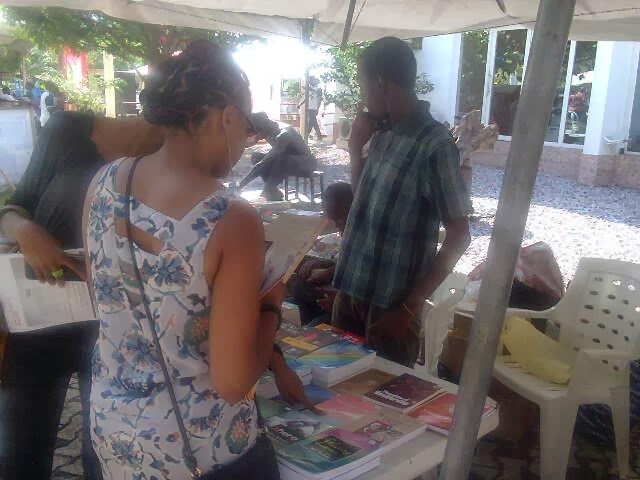
The Lagos Book  and Art Festival  or LABAF, organized annually by the Committee for Relevant Art (CORA), is a landmark event on the nation’s culture calendar with great book displays,exhibitions, live music and drama performances and of course, nuanced literary events. LABAF is Africa’s Biggest Culture Picnic for the past 15 years, the festival has become an important destination for families, literary and art enthusiasts, culture producers and even children. This year's edition which was the 15th Edition was held from 15th to 18th November at the Freedom Park, Broad Street, Lagos. Below are some photo shots from the event: